Frontpage»Northern Lights in Rovaniemi: When, Where and How to See the Aurora (An Honest Guide)
Northern Lights in Rovaniemi: When, Where and How to See the Aurora (An Honest Guide)
September 14th, 2026
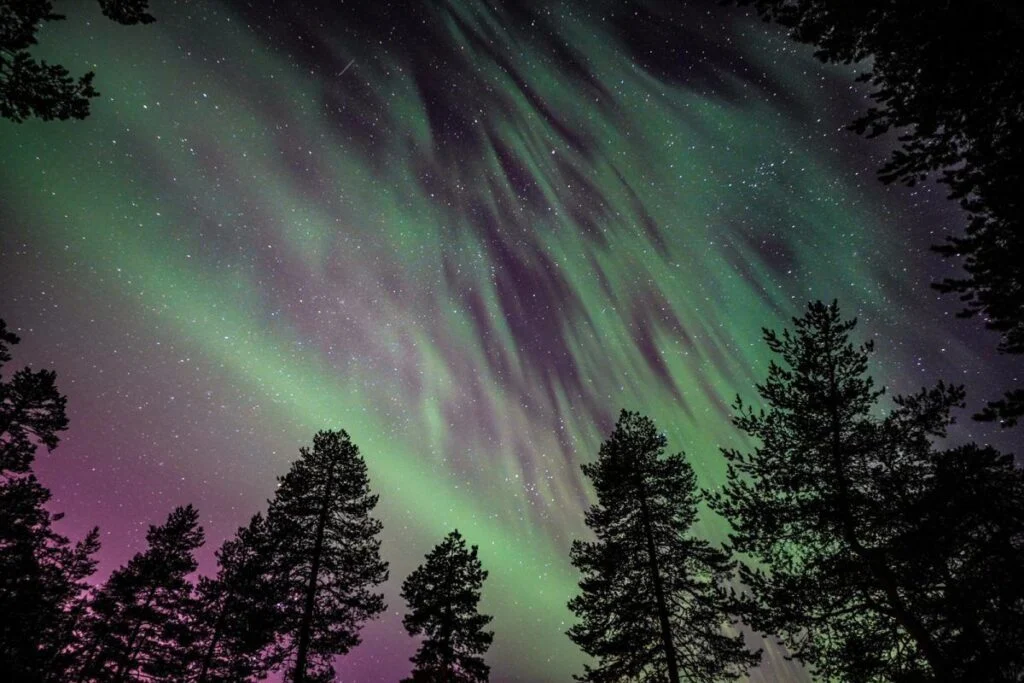
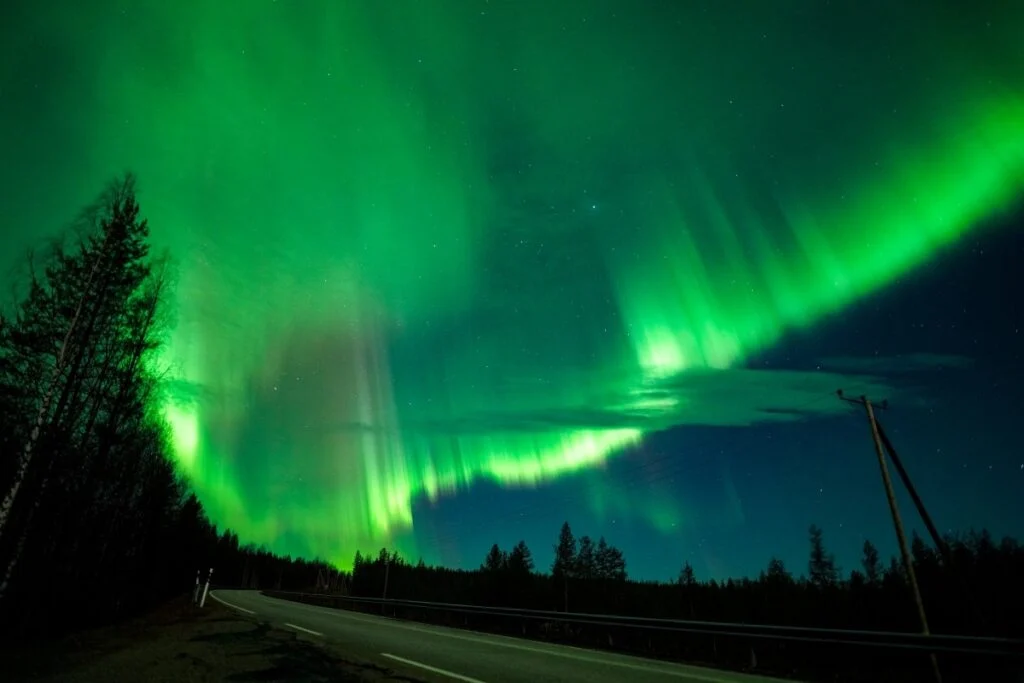
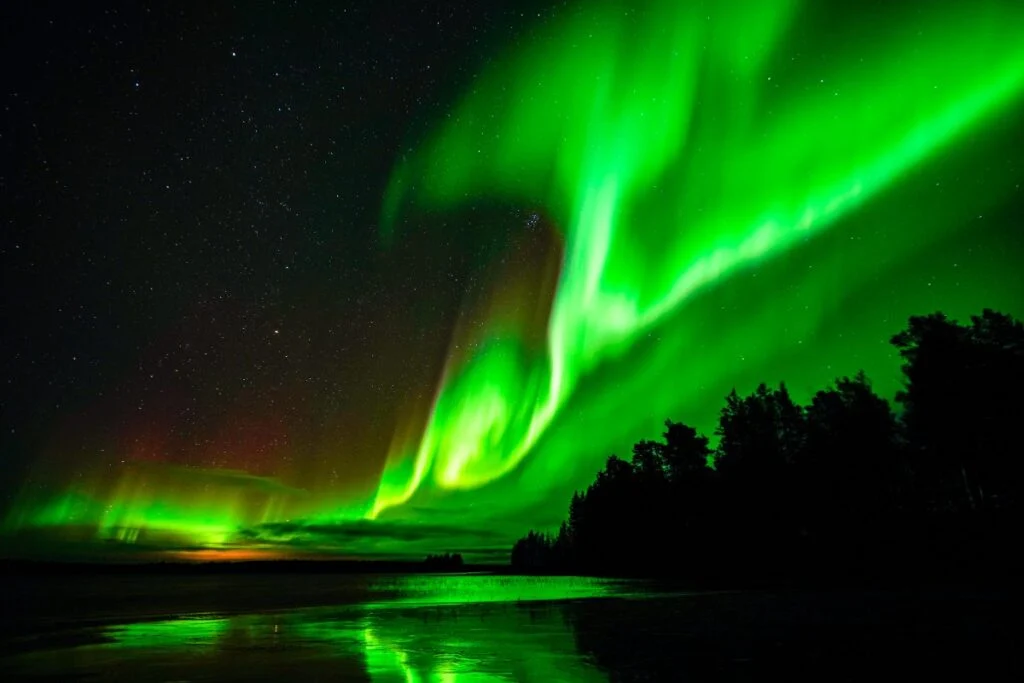
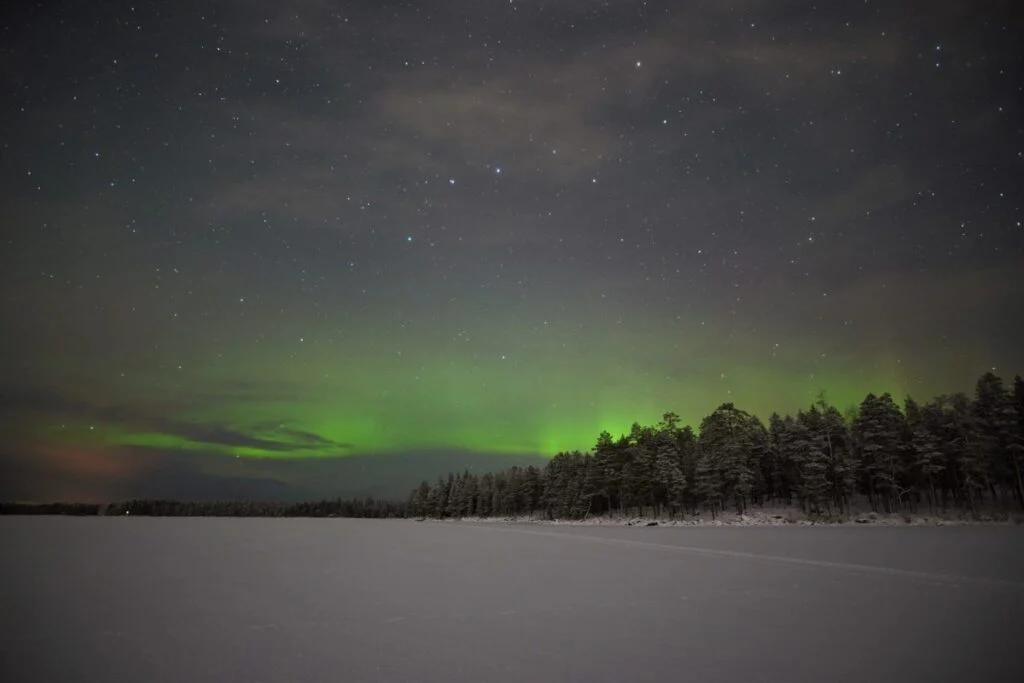
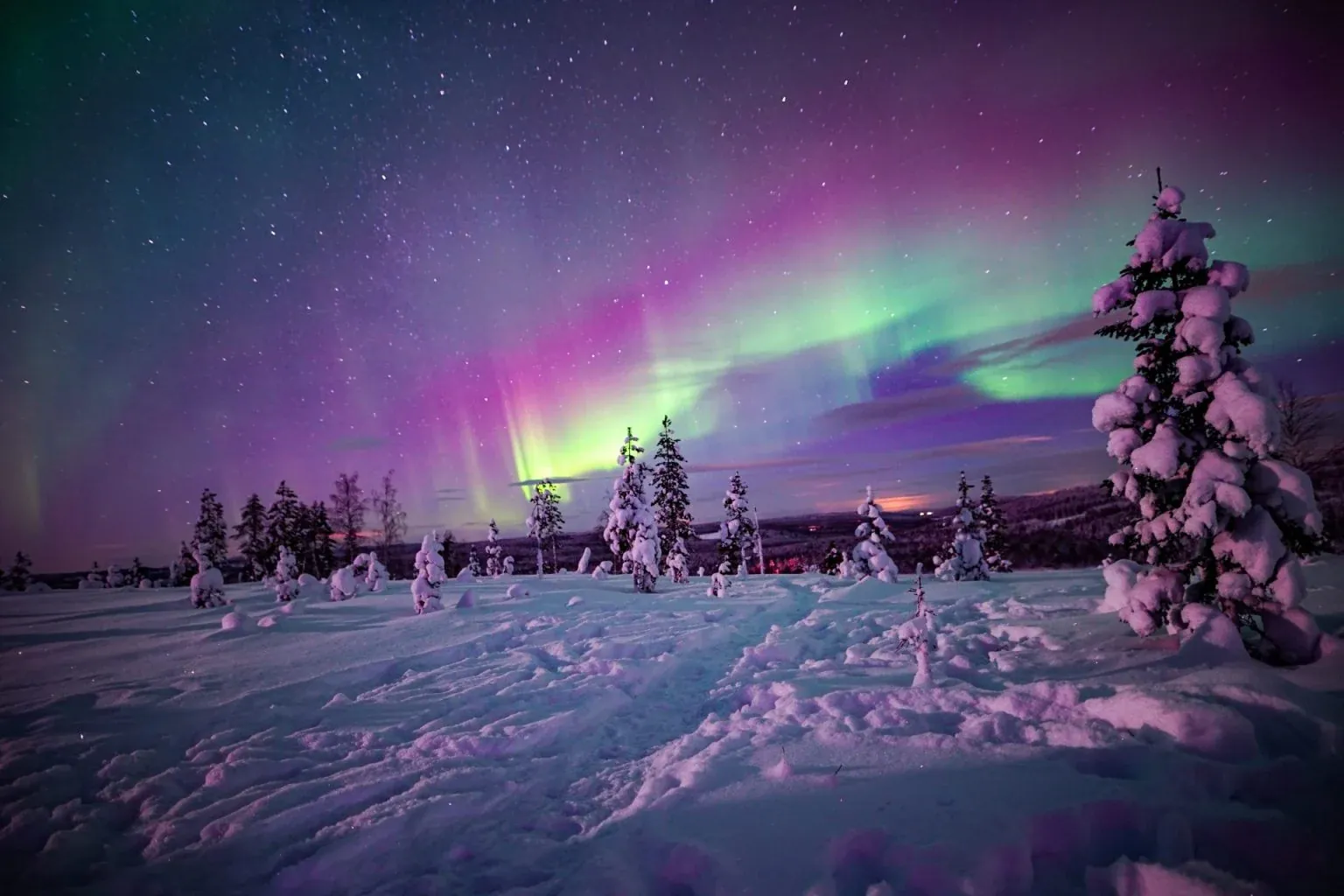
Every winter, thousands of travellers fly 90 minutes north from Helsinki to Rovaniemi with one image in their heads: a green ribbon of light dancing over a frozen forest. Some go home with that photograph. Some go home with clouds. And a few go home with something better than either — the memory of standing on a silent frozen lake at -25°C, fire crackling beside them, waiting.
This guide is written the way we run our tours: honestly. We will tell you when the Northern Lights appear over Rovaniemi, where to see them, how we read the forecast, and what we can — and cannot — promise. No overselling, no small print. This is what nearly a decade of taking small groups into the Taiga forest has taught us.
What are the Northern Lights?
The Northern Lights — Aurora Borealis — are caused by charged particles from the Sun colliding with gases in the Earth’s upper atmosphere. Oxygen glows green and, more rarely, red; nitrogen adds violet and blue. The result is the shifting curtain of light that has drawn people north for centuries.
Rovaniemi sits on the Arctic Circle, directly under the “auroral oval” — the ring around the magnetic pole where the lights are most active. That geography is the single biggest reason the city is one of the most reliable places in the world to look for the aurora. You do not need a solar storm. On a clear, dark night in season, a moderate level of activity is often enough.
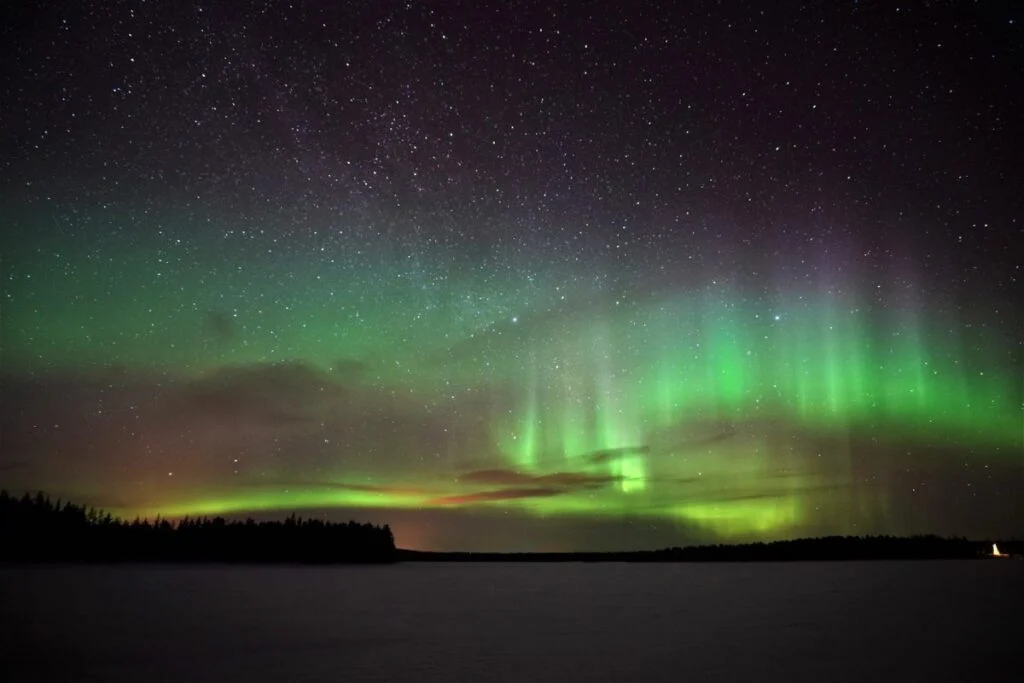
One recent discovery complicates that tidy explanation, and it did not come from a laboratory. Between 2015 and 2022, amateur astronomers in Finland and Canada kept photographing something that did not fit: isolated green structures with a faint red arc above them. Researchers who studied the images found the cause was protons rather than electrons — much heavier particles that behave differently when they reach the atmosphere. The phenomenon was named the Red Arc with Green Diffuse Aurora, or RAGDA, and Finland’s astronomical society Ursa awarded four of the photographers for the find.
You are unlikely to see one on any given night, and we are not going to pretend otherwise. But it is worth knowing that the sky above Rovaniemi is still being studied, and still turning up things nobody had catalogued.
Can you actually see the Northern Lights in Rovaniemi?
Yes — but two conditions have to line up, and neither is guaranteed by anyone.
Darkness. The aurora is always there; you simply cannot see it when the sky is bright. Rovaniemi has dark enough nights for aurora viewing from roughly late August to early April.
Clear skies. Cloud cover is the single most common reason a tour does not see the lights. This is weather, and weather in Lapland is real weather.
What we can control is getting you to the right place at the right time, away from city light, with a guide who knows where the cloud tends to break. What we cannot control is the sky itself. We would rather tell you that now, while you are choosing a date, than at midnight on a lake.
Best time and season to see the aurora in Rovaniemi
The Rovaniemi aurora season runs from late August to early April. Within that window, conditions shift:
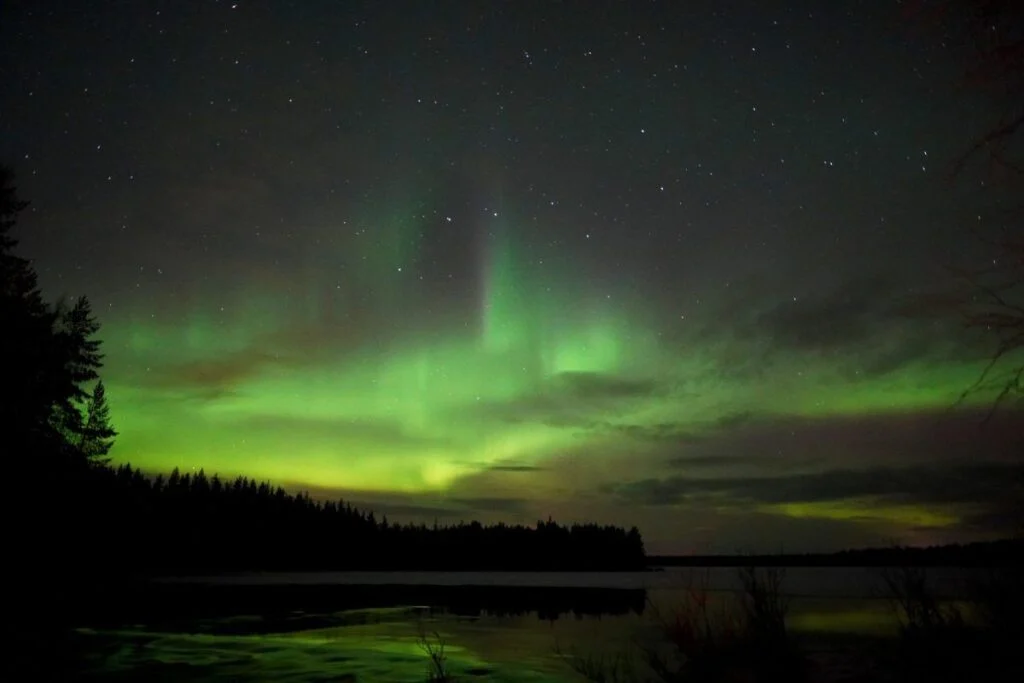
Late August–September (Ruska):Ruska is the Finnish word for the autumn colour season, when the Taiga forest turns red and gold. Nights are getting dark again and the lakes are not yet frozen — on a calm night the water gives you the aurora twice, once in the sky and once in the reflection. A photographer’s favourite.
October–November: Long dark nights arrive, snow begins, and aurora activity is often strong around the autumn equinox period. Fewer crowds than midwinter.
December–January: The polar twilight, when the sun barely clears the horizon and midday is one long blue hour. Very short days mean long viewing windows — but also the coldest, most variable weather. This is the classic Christmas-season Lapland visit.
February–March: Many guides’ favourite. Deep snow, longer and brighter days for daytime activities, statistically settled clear spells, and strong aurora activity around the spring equinox.
The lights themselves do not “peak” at a single hour, but activity is most often visible between roughly 21:00 and 01:00. That is why most of our aurora tours start in the evening and stay out late — we would rather wait with you than rush back.
Where to see the Northern Lights around Rovaniemi
You can occasionally catch the aurora from the edge of the city on a strong, clear night. But streetlights wash out all but the brightest displays, so we drive away from them. On our tours, your guide will typically drive around 50 kilometres out of Rovaniemi (up to 300 kilometres on our Guaranteed Northern Lights Hunting Adventure, which on the most stubborn nights means crossing into Sweden or Norway to find the gap) to find dark sky and an open horizon — a frozen lake, a clearing in the Taiga forest, or a quiet riverbank.
We do not take you to Santa Claus Village tourist clusters to look for the lights. We take you to places where you can switch your head torch off, let your eyes adjust, and hear nothing but the fire. The darker the foreground, the better both the experience and the photograph.
How we read the forecast: KP index, cloud cover and the moon
There is no app that “guarantees” the aurora, but there are three numbers we watch every day in season, and you can watch them too.
KP index (0–9): A rough global measure of geomagnetic activity. At Rovaniemi’s latitude, even KP 1–3 can be enough for a visible display on a clear, dark night — you do not need a big storm. We treat KP as a guide, not a promise.
Cloud cover: The decider. We use Finnish Meteorological Institute forecasts and local radar to find the gaps. Sometimes that means driving 40 minutes to a different lake because the sky is clear there and closed in over the city.
The moon: A bright full moon lifts the landscape beautifully for photos but can mute faint aurora. A darker moon phase favours faint-detail viewing.
We explain all of this because a guest who understands the sky waits better, and waiting is most of the job. Nobody enjoys standing in the cold wondering whether the guide knows something they are not saying.
Our honest promise about the Northern Lights
Here is the line we will not cross: we do not promise sightings. The aurora is weather and space weather at the same time, and certainty is not ours to sell.
What we promise instead:
We go out every time there is a chance. If there is a realistic window, we are out in it.
We tell you the truth before you commit. The cloud forecast, the KP outlook, the moon phase — you hear them all before you decide, not after.
We keep the group small. Every Wild About Lapland tour is capped at a maximum of 8 guests — no exceptions, no matter how busy the season.
We do run one tour built specifically to maximise your chances — the Guaranteed Northern Lights Hunting Adventure — and even there we are transparent about what “guaranteed” means: if we have to cancel the tour because of the weather or other unforeseen circumstances, or if the Northern Lights are not captured on camera during it, you receive a 100% refund. That is a promise about money, not about the sky, and we would rather you read it here than find it in the booking terms.
Northern Lights tours from Rovaniemi (maximum 8 guests)
Our aurora tours all start in Rovaniemi and head into real wilderness. A few of the ways you can chase the lights with us:
Northern Lights Wilderness Tour with Professional Camera: Into the Taiga forest in the Arctic Circle, where you watch from beside a fire or on a frozen lake. A professional aurora guide brings a professional camera and captures memorable photos for you.
Private Northern Lights Tour: Just your party and a guide, for couples, families or photographers who want their own pace.
Snowmobile and snowshoe aurora combinations: Pair the lights with another activity — see our snowmobile safari guide for how the driving works.
Every tour includes a real professional outdoor instructor at the front, round-trip transport from Rovaniemi, hot drinks and Finnish campfire snacks, and — in winter — free professional thermal overalls and winter boots. For the full picture of a winter trip, see our guide to things to do in Rovaniemi in winter.
What to wear when it is -30°C
It can be as cold as -30°C in Lapland, and standing still to watch the aurora is colder than moving. In winter we provide free professional thermal overalls (designed for extreme temperatures) and winter boots — they go on over your own clothes. We recommend you bring:
Good inner layers (thermal underwear)
A warm hat
Two pairs of thick socks
Winter gloves
Hats, socks and gloves are not included, but if you forget any of them you can buy them at our office at Rovakatu 24. Dress for standing still in the cold, not for walking — that is the mistake first-time visitors make most often.
Photographing the aurora
You do not need professional gear to come home with a photograph, but a few things help:
A tripod or a steady surface. Aurora shots need long exposures, and you cannot hold a camera still enough by hand.
Manual mode (or your phone’s night mode). Start around a 5–15 second exposure, ISO 1600–3200, and adjust.
A spare battery, kept warm. Cold drains batteries fast; keep one in an inner pocket.
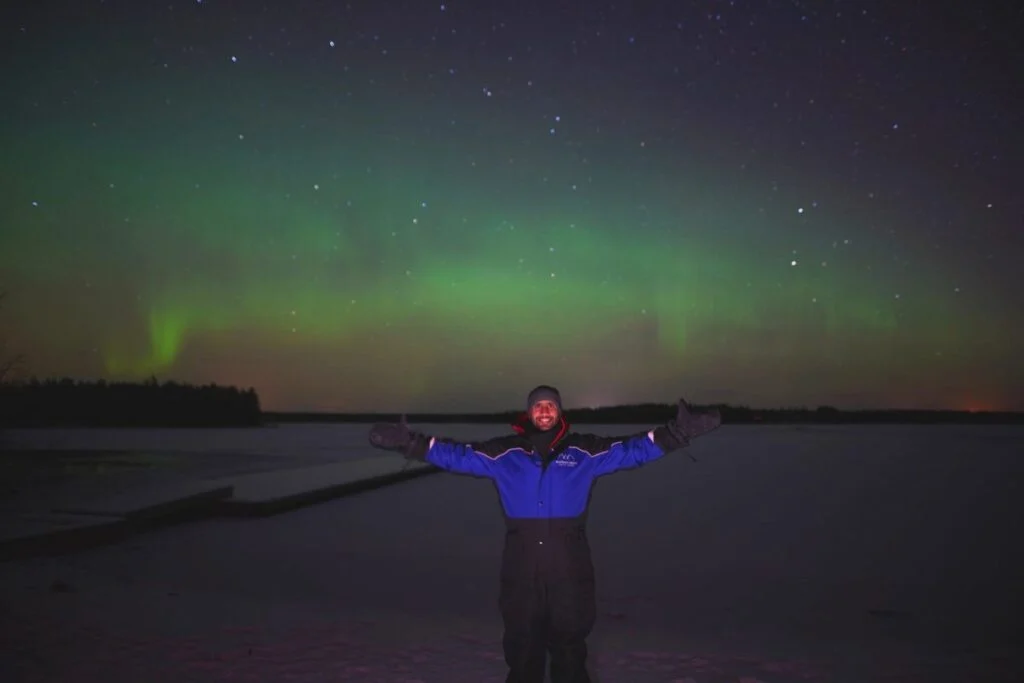
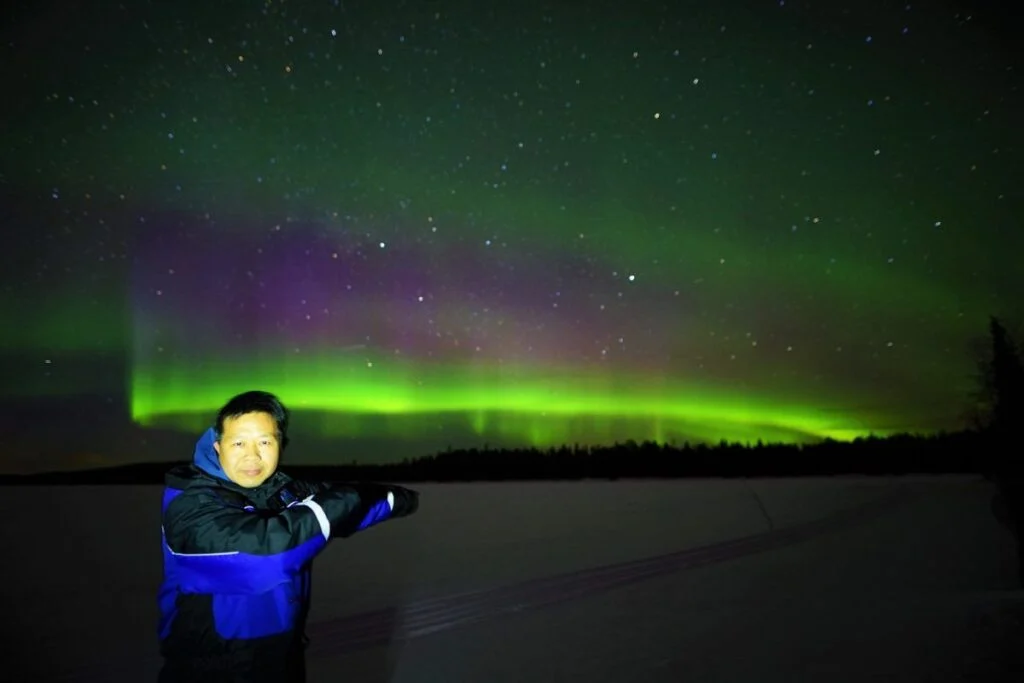
On the Northern Lights Wilderness Tour, a professional aurora guide brings a professional camera and takes photos of you under the lights — so you can put your own phone down and simply be there. Because, in the end, that is the point.
Why a small group changes the night
A bus tour drops 50 strangers at one overlook on a fixed schedule. If the lights come late, the bus still leaves. We have built the opposite: a maximum of 8 guests, a guide who knows your name by the end of the night, and the freedom to stay an extra hour when the aurora is dancing.
That choice comes from who we are. Wild About Lapland was founded in Rovaniemi in 2016 by Theo Turner, a former Royal Marines Commando and Professional Outdoor Instructor, on the conviction that the Arctic deserves to be experienced, not consumed. We hold the Sustainable Travel Finland™ certification (2024) and the Biosphere Certificate for sustainable tourism, our vehicles run on renewable diesel — and the same thinking sets the group size: small enough to leave the lake as quiet as we found it. You can read more on our sustainability commitment.
Frequently asked questions
When is the best month to see the Northern Lights in Rovaniemi? There is no single best month. September offers aurora over autumn colour and open water; December–January gives the longest dark windows; February–March combines deep snow, strong activity and more daylight for other activities. All are good — the deciding factor is clear sky on the night.
Are the Northern Lights guaranteed? No, and we will never tell you they are. The aurora is a natural phenomenon. We go out every time there is a chance and we are honest about the forecast. Our Guaranteed Northern Lights Hunting Adventure carries a 100% refund if the lights are not captured on camera during the tour, which we explain openly.
What KP index do I need in Rovaniemi? Because Rovaniemi sits under the auroral oval, even a KP of 1–3 can produce a visible display on a clear, dark night. Cloud cover matters more than the KP number.
Can you see the Northern Lights from Rovaniemi city centre? Occasionally, on a strong, clear night — but streetlights wash out fainter displays. We drive around 50 km out of the city to dark sky and an open horizon.
How cold does it get on a Northern Lights tour? It can reach -30°C. We provide free professional thermal overalls and winter boots; you bring inner layers, a hat, thick socks and gloves.
How many people are on a Wild About Lapland aurora tour? A maximum of 8 guests on every tour, every season — without exception.
Do I need a camera? No. A professional aurora guide on the Northern Lights Wilderness Tour photographs you under the lights. If you want to shoot your own, bring a tripod and a spare battery.
What if it is cloudy? We monitor the forecast and drive to find clear sky where we can. If the cloud is total across the region, we say so plainly before the tour — and on the Guaranteed tour, the 100% refund applies.
Plan your aurora night with us
The Northern Lights are the reason most people come to Rovaniemi. The silence of the Taiga forest at -25°C, the fire on a frozen lake, and a guide who is in no hurry to leave — those are the reasons people remember it.
Book a Northern Lights tour with Wild About Lapland — a maximum of 8 guests, a professional outdoor instructor at the front, and a straight answer about the sky before you commit.
Written by the Wild About Lapland team in Rovaniemi. Our founder and lead guide, Theo Turner, is a former Royal Marines Commando and Professional Outdoor Instructor with extensive understanding of the Northern Lights and wilderness conditions in Finnish Lapland. Wild About Lapland has operated small-group Arctic tours from Rovaniemi since 2016 and is Sustainable Travel Finland™ certified (2024).